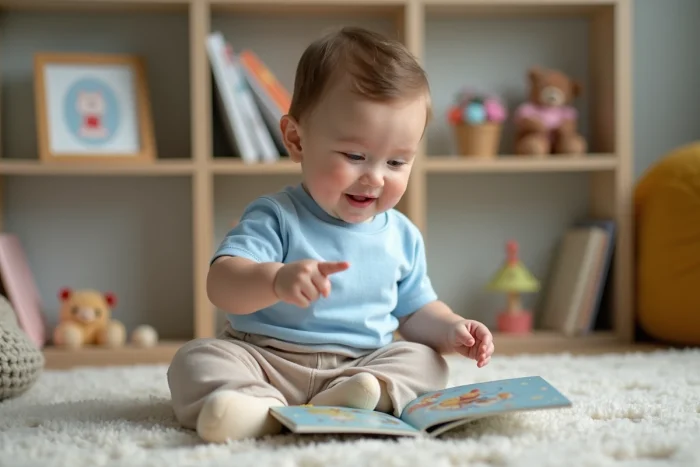
At 20 months, some children already pronounce more than fifty words, while others barely express themselves with a few sounds. A rapid progression can follow several weeks of apparent stagnation, without necessarily indicating a disorder. Notable variations exist among children, with sometimes significant gaps, even within the same sibling group.
Early detection of certain signals, such as the absence of two-word combinations or the persistent use of gestures instead of words, facilitates support. Understanding the expected milestones and atypical signs allows for guidance towards appropriate solutions if needed.
Understanding the major language milestones at 20 months: what changes in your child
Twenty months is that moment when language emerges, surprises, and progresses in fits and starts. The child attempts novel combinations, starts mini-phrases like “more water” or “mom gone,” using gestures to support their speech. Their vocabulary can suddenly expand, then stagnate; each child charts their own path at their own pace.
Some little ones can string together 30 words, while others prefer sounds or miming. In terms of comprehension, they grasp much more than they can express. Barely half of the understood words actually come out of their mouths: before the age of 2, it is not uncommon for them to understand over a thousand simple concepts or instructions, while they will only say a fraction of them.
Daily interactions play a key role: talking, naming, storytelling, singing. All these interactions gradually build the foundations of language, long before the child constructs real sentences. This immersion in sounds and words, offered without pressure, nurtures curiosity and a thirst for learning. This is what enriches language development at 20 months.
The journey of language shows a progression: the very first coos at 3 months, babbling at 7 months, then the emergence of small words around one year. Between 16 and 19 months, the association of two words takes hold, a prelude to future complex sentences. This patient construction is unique to each child; it is experienced as much as it is guided.
What words and phrases can a 20-month-old child say? Concrete benchmarks for parents
Over the weeks, the vocabulary expands unexpectedly. Most 20-month-old children use between 20 and 40 words, sometimes more, depending on their temperament or the environment provided. The child often names family members, animals, their toys, or body parts. And when the famous “no” emerges, it often marks a well-defined personality.
The pivotal stage? The combination of two words. “Dad gone,” “want cake,” “no sleep”: the construction still appears fragile, but it signifies a significant advancement. Pronunciation may waver, some words may be distorted, but what matters is being understood by the accompanying adult.
To illustrate the diversity of progress around 20 months, here are several skills that are often observed:
- Use of their name: the child begins to refer to themselves by saying their own name before transitioning to “me” or “I” between 18 and 24 months.
- Imitation of sounds: around 21 months, they love to reproduce everyday sounds, imitating the dog or the car, exploring the modulations of their voice.
- Nursery rhymes and books: singing a few syllables of a song, naming simple images in a book, are all small victories that nurture expression.
Offering short stories, playing memory games, or giving simple instructions are other ways to support this dynamic. There is no need to rush things: each child marks their own milestones, guided by their thirst for discovery, their desire to interact, and, very often, the pleasure of surprising themselves with what they understand or repeat. All of this shapes a pivotal period, where questions arise, leading to new learning.
When to be concerned about a language delay and how to support with confidence
Every child develops at their own pace, but certain signals deserve attention. At 20 months, if no words have been spoken, if simple instructions seem misunderstood, or if the child continuously avoids speaking in favor of silent gestures, a medical opinion is warranted. Around the age of 2, an absence of two-word combinations or a lasting blockage in expression should be assessed without delay.
The speech therapist, in consultation with the pediatrician, analyzes these situations. The assessment identifies whether it is a small temporary delay or a disorder that requires specific follow-up. It is often a matter of acting early, but without dramatizing. To identify and support, here are some signals to observe:
- Consultation: seek a professional if your child has not spoken any words by 20 months.
- Observation: pay attention to how they point, look, or imitate, well beyond words.
- Interaction: increase exchanges, improvise songs, play, read together: it is the adult who opens the door to the world of language.
Seeking preventive advice does not mean there is a serious alert. A rich environment and daily exchanges are sometimes enough to reignite learning. Detecting certain delays early prevents obstacles when starting school and boosts the confidence of both parents and children. Navigating together in language learning means moving forward hand in hand, allowing the first words to emerge, and being surprised one morning by hearing a sentence that didn’t exist the day before.