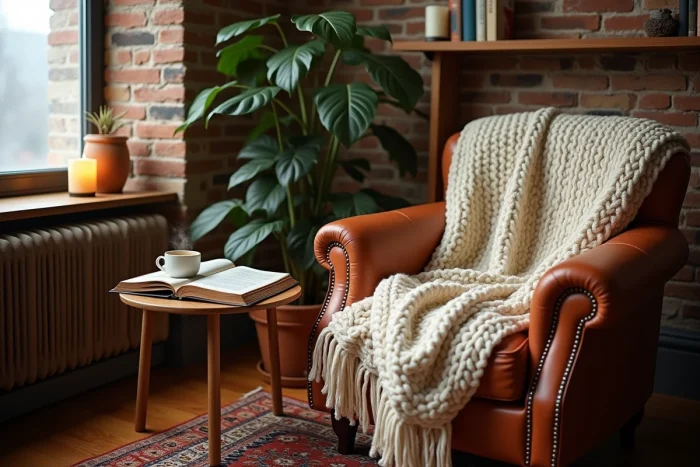
A room can be well-furnished, well-organized, and still give the impression of a cold space. The problem rarely lies with the furniture. It often comes down to three overlooked factors: the temperature of the walls, the quality of the light, and the choice of materials in contact with the skin. Transforming your home into a warm cocoon involves these concrete levers, well before accumulating cushions.
Real thermal comfort: what makes a room warm before decoration
You may have noticed that a room heated to a good temperature can feel cold when you sit near an exterior wall? It’s not just an impression. The Ademe explains in its brochure “Thermal Comfort in Housing” updated in 2024 that the comfort felt depends as much on the temperature of the walls as on that of the air.
A poorly insulated wall or low-performance glazing radiates cold inward. Adding a throw on the sofa placed against this wall does nothing to solve the problem. The priority, before any cozy decoration, is to address these cold walls and eliminate unwanted air leaks.
Three actions have a direct effect on the thermal ambiance of a room:
- Hanging thick curtains in front of single or double-glazed windows, leaving an air gap between the fabric and the glass, acts as an additional textile insulator.
- Installing a dense rug on a tiled or concrete floor reduces the sensation of cold underfoot, where bodily contact is constant.
- Moving seating away from uninsulated exterior walls increases comfort without touching the heating.
These adjustments are as much about thermal common sense as they are about interior decoration. They create a real gain in perceived warmth, not just a visual ambiance. If you’re looking for ideas to rethink the layout room by room, you can visit the Niddou website, which brings together resources on housing and daily life at home.

Light and cocooning ambiance: adjusting lighting by zones
A central ceiling light turned on alone produces flat, lifeless light. The living room then appears as welcoming as a waiting room. The key to a cozy atmosphere lies in multiplying low light sources, placed at eye level or below.
Layering three levels of light
The principle is simple. Each usage zone receives its own light source. The reading nook needs an adjustable table lamp. The dining area gains warmth with a pendant light placed low above the table. The back of the room comes alive with a warm white LED string light or a candle placed on a shelf.
Why does this segmentation work? Because it replicates the logic of a fireplace: light coming from below, not illuminating everything uniformly, and leaving areas of shadow. The brain associates this configuration with rest.
Choosing the right color temperature
Bulbs above 4,000 kelvins lean towards bluish white. They are suitable for a kitchen worktop, not for a cozy living room. Opt for bulbs between 2,200 and 2,700 kelvins for living spaces. This information is indicated on the packaging of any bulb sold in France.
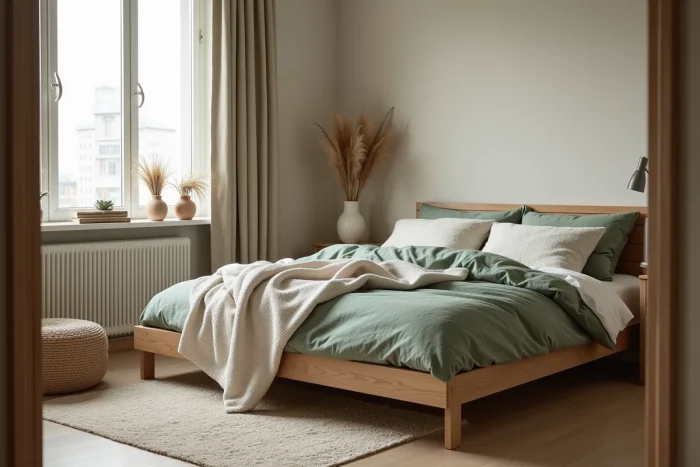
Materials and indoor air quality: decorating without polluting
Articles on cozy decor recommend scented candles, wooden furniture, colorful paints. They rarely mention what these elements emit into the air once installed in your home.
In 2023, Anses published an opinion on volatile organic compounds (VOCs) emitted by construction and decoration materials. Paints, varnishes, glues, and furniture made from engineered wood are among the main sources of indoor pollution. In a space you want to transform into a cocoon, air quality matters as much as aesthetics.
Identifying reliable labels on decoration materials
Mandatory health labeling in France classifies construction and decoration products from A+ (very low emissions) to C (high emissions). Choosing products consistently rated A+ for wall paints, floor coverings, and furniture panels reduces exposure to VOCs in enclosed spaces.
- For paints, ranges labeled A+ and bearing the European Ecolabel guarantee very low VOC levels after application.
- For wooden furniture, solid wood emits less formaldehyde than low-end melamine particle board.
- For candles and ambient fragrances, Anses recommends airing the room after use and limiting frequency of use, as these products emit fine particles and VOCs even in small amounts.
Decorating with raw natural materials (linen, wool, solid wood, terracotta) allows you to achieve the desired warm aesthetic while limiting pollutant emissions. It’s a cozy decor choice that also protects health.
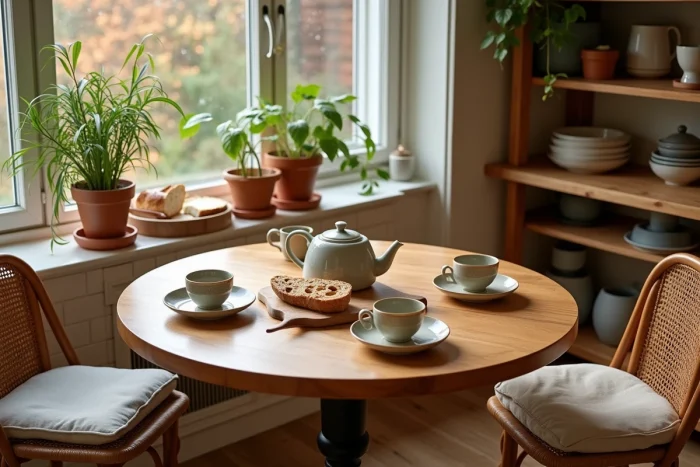
Warm colors for a cozy interior: shades that really work
The cocooning palettes seen everywhere revolve around beige, off-white, and greige. These shades are safe, but they are not enough to create a sense of enveloping warmth. An accent wall in an earthy tone, ochre, or terracotta transforms the perception of a space much more than a total neutral look.
The principle is based on soft contrast. A fully beige living room appears flat. The same living room with just one wall painted in warm brown or dark sage green gains depth. The eye is drawn to this wall, making the room feel more intimate.
Pair this accent wall with textiles in complementary tones: honey-colored linen cushions, ecru wool throw, thick cotton curtains slightly darker than the adjacent walls. The accumulation of different textures in the same color range creates the feeling of a cocoon, not the multiplication of patterns.
Exposed wood, whether it’s a shelf, a mirror frame, or a table top, anchors the palette in a natural ambiance. Combined with textile fibers and warm lighting, it forms the foundation of a coherent cocooning decor, without falling into catalog style.
A warm interior is not built with an online order. It is constructed by first correcting what truly cools the room, then working on light, materials, and colors in that order. The result lasts because it is based on technical choices as much as on aesthetic preferences.