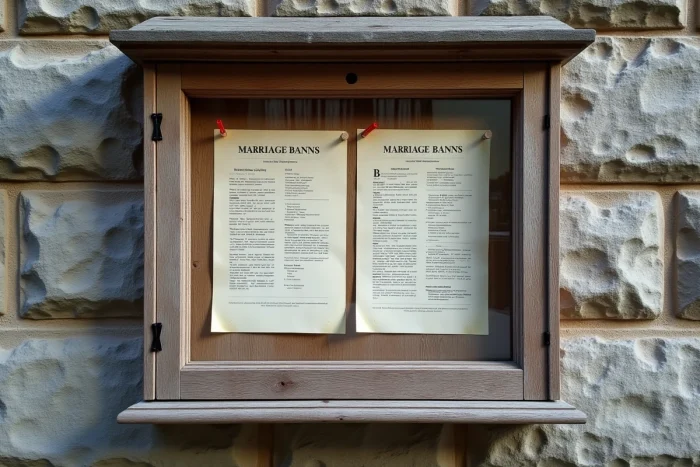
When preparing a wedding in Saint-Malo, one first thinks of the ceremony venue, the caterer, and the invitations. The publication of the banns often takes a back seat. However, it is a mandatory step imposed by the Civil Code, and its absence can block the celebration.
Digital Display of Banns in Saint-Malo: What Changes in Practice
Article 64 of the Civil Code mentions a display “at the door of the town hall.” For a long time, this meant a sheet pinned in the town hall lobby. Several major French cities have begun to switch to exclusively digital display on the town hall’s website, considering that the text does not specify the medium.
This shift towards e-publicity of the banns is discussed in recent legal doctrine. For future spouses in Saint-Malo, this means that verifying the publication no longer necessarily requires a physical trip. A visit to the municipality’s website may be enough to confirm that the announcement has indeed been posted online.
If you are wondering why to publish the marriage banns in Saint-Malo, the answer can be summed up in one word: transparency. The goal remains to allow anyone aware of a legal impediment to report it before the celebration.
Impediments to Marriage: What the Banns Help to Detect
Why make an intention to marry public? Because some obstacles do not appear in any administrative file. A prohibited kinship, a union still in effect in another country, a lack of free consent: these situations exist, and the publication of the banns is the only preventive mechanism provided by law.

In practice, anyone can file an opposition to the marriage during the display period. The civil status officer of the municipality of residence of each spouse is then required to examine this opposition before celebrating the union.
Here are the most common grounds for opposition:
- An undissolved previous marriage, including a marriage celebrated abroad and not transcribed in France
- A kinship or alliance at a degree prohibited by the Civil Code
- The absence of free consent from one of the future spouses, reported by a family member
In the absence of regular publication, a third party could demonstrate that they were deprived of their right to file an opposition. This irregularity can, in some cases, lead to the annulment of the marriage if harm is proven.
Marriage File at the Town Hall: Documents Required in Saint-Malo
The publication of the banns does not occur automatically. It takes place after the submission of a complete file to the town hall of the municipality where the marriage will be celebrated, or to the municipality of residence of one of the spouses.
The documents usually required to constitute this file include:
- A birth certificate less than three months old for each future spouse (or less than six months if the certificate was issued in an overseas territory or a consulate)
- A valid identification document
- A proof of residence or domicile in the municipality
- The list of witnesses with their names, first names, dates and places of birth, professions, and addresses
- A certificate from the notary in case of a marriage contract
Once the file is validated, the civil status officer proceeds with the publication. The legal display period is ten days before the scheduled date of the ceremony. This period runs from the day after the display. If the marriage is not celebrated within the year following the publication, the entire procedure must be renewed.
Banns and Marriage Abroad: The Case of Expatriated Malouins
The publication of the banns also concerns couples where one of the future spouses resides outside France. In this case, the display occurs both in the relevant French municipality and at the competent consulate or embassy.
For a Malouin marrying abroad, the banns must be published in Saint-Malo if it is his last municipality of residence in France. The consulate then issues a certificate of capacity to marry, a document that certifies that the French formalities have been properly completed.

This certificate has no equivalent in all countries. Some states do not recognize it, which can complicate the transcription of the foreign marriage certificate into the French civil status registers. Checking the requirements of the country of celebration in advance avoids administrative blockages after the ceremony.
Banns Archives in Saint-Malo: A Resource for Genealogists
The registers of publication of banns are not only for future married couples. The departmental archives of Ille-et-Vilaine keep these registers in the municipal and civil status series. They allow for the reconstruction of uncelebrated unions, marriages moved from one municipality to another, or oppositions filed at a given time.
For genealogy researchers, the banns constitute a complementary source to marriage certificates. A bann published without a subsequent marriage sometimes tells a story that the birth or death certificate does not reveal: a family opposition, a change of residence, a departure to the colonies.
With the reform brought by law n°2022-301 of March 2, 2022, and the ordinance of July 13, 2022, several civil status formalities have been simplified or digitized. The prior publicity through the banns remains maintained, including for municipalities like Saint-Malo. Future spouses who submit their marriage file at the town hall participate, often without realizing it, in the creation of public archives that can be consulted by future generations.