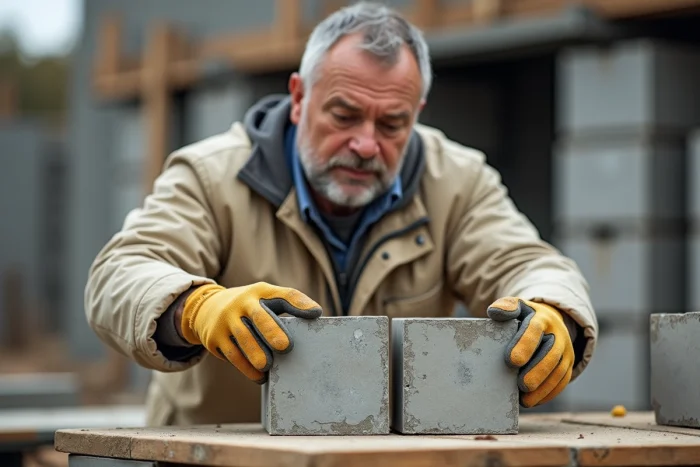
On a renovation site in a suburban area, the mason orders “agglos.” The supplier delivers concrete blocks. No one reacts, because in most cases, it is the same product: a molded concrete block, hollow or solid, made of aggregates, cement, and water.
The confusion between the two terms is more geographical than a real technical difference. “Agglo” is used in certain regions (southwest, center), “parpaing” in others (north, Île-de-France), and “moellon” elsewhere. Understanding the differences between agglo and parpaing mainly involves distinguishing the variations of the same material and choosing the block suitable for each structural use.
Recycled agglos and parpaings: a lever for HQE certification in new construction
Classic guides on concrete blocks overlook a growing use in recent years: the integration of recycled aggregates from deconstruction in the production of parpaings and agglos. Blocks containing a significant proportion of crushed concrete are gradually replacing virgin aggregates from quarries on certain new construction sites aiming for HQE certification. To better understand the differences between agglo and parpaing in construction, it is also necessary to look at these new production channels.
The interest for project owners is twofold. First, the traceability of recycled materials directly feeds into the Environmental Product Declaration (FDES), which is significant in the “materials” aspect of the certification. Secondly, using recycled blocks reduces the carbon footprint of the structural work, a component scrutinized by RE2020.
Feedback varies on this point: not all manufacturers yet guarantee the same mechanical resistance with 100% recycled aggregates. It is observed that partially recycled blocks (mixed aggregates) are more common on certified sites, as they combine validated structural performance with measurable environmental benefits.
Dry vibrated parpaing or cast agglo: what really changes on site
The most useful distinction on the ground does not oppose “agglo” to “parpaing” as different materials, but rather two manufacturing processes that produce blocks with distinct behaviors.
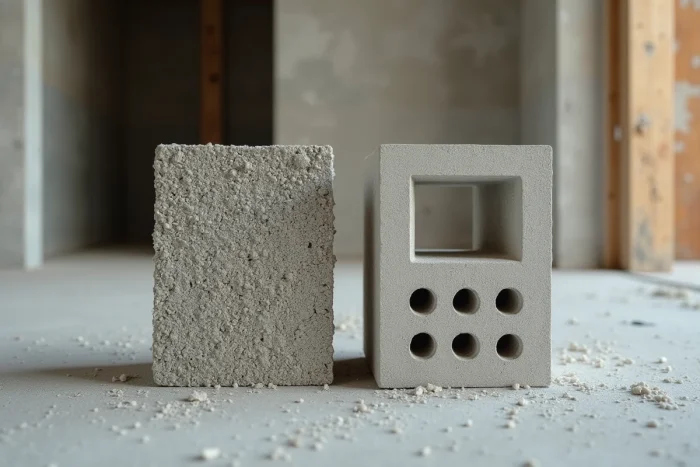
- The dry vibrated parpaing is compacted by vibration in a mold without excess water. Its rough surface promotes the adhesion of coatings and adhesive mortars. The FFB reports a growing preference among masons for this type of block in heavy renovation since mid-2024, with a reduction in cracks observed on some pilot sites.
- The cast agglo, smoother on the surface, sometimes requires an additional rough coat (bonding layer) before applying the finish. It remains widespread in new construction where external insulation masks the block’s finish.
- In terms of handling, dry vibrated blocks have a slightly higher density at equal volume, which makes manual installation heavier but improves the thermal inertia of the finished wall.
For an internal partition wall where flatness matters, the smooth agglo is suitable. For an exterior wall intended to receive a single-layer coating, the dry vibrated parpaing reduces the risk of detachment.
Seismic resistance of reinforced parpaings versus traditional agglos
In seismic zones, the choice of block is not trivial. The 2025 update of Eurocode 8 (NF EN 1998-1) confirms that reinforced perforated parpaings outperform traditional hollow agglos in ductility. The vertical cavities of the perforated block allow for continuous reinforced concrete chains to be poured along the entire height of the wall, which better absorbs lateral stresses during an earthquake.
A classic hollow agglo of type B40, assembled with traditional mortar, offers adequate compressive strength for low seismicity areas. Once the project is located in a moderate seismicity zone or higher, the structural engineering office will almost systematically impose formwork blocks or perforated parpaings with vertical reinforcements.
NF EN 771-3 standard and biosourced agglos: a point of vigilance
The decree of January 15, 2025, extended the NF EN 771-3 certification to lightweight agglos incorporating biosourced components (hemp, flax). These blocks are now subject to enhanced testing for durability in humid areas. Some local agglos, produced without this certification, are no longer compliant for load-bearing walls in new buildings. Before ordering, it is essential to check that the block bears the updated NF marking.
Thermal insulation of concrete blocks: what the material alone does not solve
Neither agglo nor parpaing constitutes an insulation system by themselves. The concrete block, regardless of its regional name, has interesting thermal inertia due to its mineral mass, but its intrinsic thermal resistance remains low. It is always associated with an insulator, either from the inside or the outside.
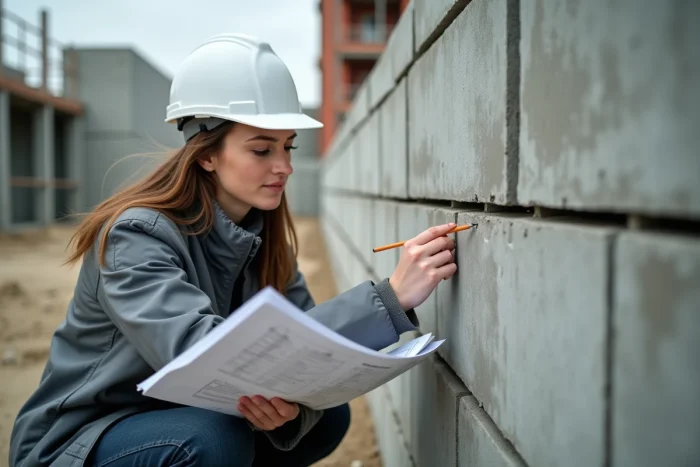
The real decision lies in the type of cladding. A wall made of 20 cm parpaings with external thermal insulation (ITE) eliminates thermal bridges at the floor-wall junctions, a decisive advantage for meeting RE2020 thresholds. The same wall with internal thermal insulation (ITI) retains thermal bridges at the slab edges, unless thermal breaks are added, which increases the cost of the masonry lot.
The choice between hollow agglo and solid parpaing also influences the installation of the insulation. A hollow block facilitates the passage of technical ducts through the cavities, while a solid block offers better resistance for fixing heavy loads (tall furniture, water heaters) directly into the wall.
The concrete block remains the most widely used construction material in France. Whether the supplier calls it agglo, parpaing, or moellon, it is the variant of the block (hollow, solid, perforated, formwork, recycled) and the context of the project that guide the choice.
Check the NF marking, specify the desired manufacturing process, and anticipate the insulation system from the design of the load-bearing wall: these are the three decisions that matter before placing an order.