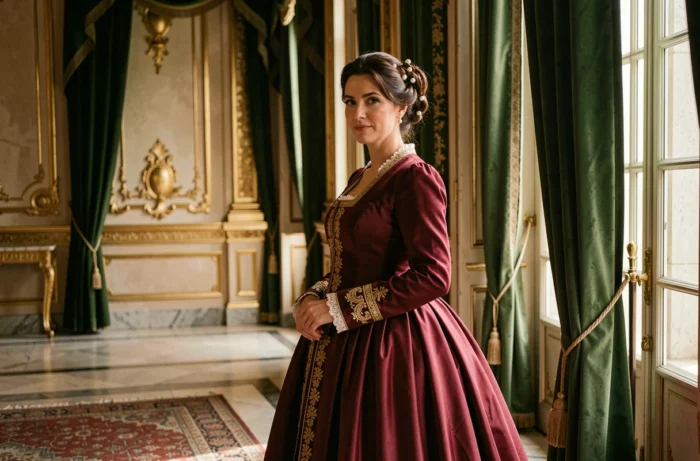
Marie-Valérie of Austria, born on April 22, 1868, in Budapest, is the fourth and last child of Emperor Franz Joseph I and Empress Elisabeth, known as Sissi. Her place in the imperial family remains unique: the only child truly raised by her mother, she lived through the decades that witnessed the collapse of the Austro-Hungarian Empire. However, her traces can still be found in places and documents that the legend of Sissi has largely overshadowed.
The diary of Marie-Valérie, a direct source on the imperial family
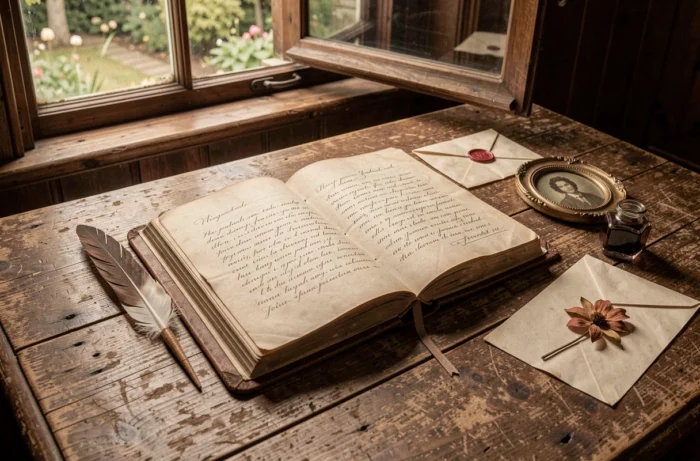
Most accounts dedicated to Sissi rely on biographies written retrospectively, diplomatic correspondence, or memoirs of courtiers. Marie-Valérie’s diary offers a different perspective: that of a daughter observing her mother from within the family circle.
This diary is presented by historians as a preserved source for studying the daily life of the imperial family. It is not just a simple anecdotal memory. Marie-Valérie’s notes allow for a confrontation between the romanticized image of Sissi, constructed by cinema and popular literature, and testimonies produced by a direct member of the dynasty.
The exact nature of the published edition and the location of the original manuscript deserve verification in an archive catalog, as the available data do not allow for a precise conclusion on this point.
To delve deeper into the journey of this archduchess often reduced to a secondary role, a file dedicated to Marie-Valérie of Austria on Famille XH puts into perspective the gray areas between myth and historical reality.
Marie-Valérie of Austria and Hungary: a political name
The choice of the name “Valérie” was not random. Elisabeth, deeply attached to Hungary, wanted her daughter to embody this connection.
This political dimension explains why Marie-Valérie was long nicknamed “the child of Hungary.” On the other hand, the rumor that she was the daughter of Count Andrássy, a close advisor to Elisabeth, has never been supported by documentary evidence. It persists in popular culture and fuels legends surrounding Sissi, but no archival source confirms this hypothesis.
This rumor illustrates a recurring mechanism in Habsburg historiography: the fascination for supposed scandals often takes precedence over the analysis of actual political choices. The name “Valérie,” by itself, tells more about the power dynamics between Vienna and Budapest than any dynastic speculation.
Love marriage and life at Wallsee: an archduchess in retreat
Marie-Valérie married Archduke Franz Salvator of Habsburg-Tuscany. This marriage, presented as a love match, was a notable exception in a dynasty where unions were predominantly dictated by diplomacy. Elisabeth is said to have supported this freedom of choice, in contrast to her own marital experience.
The couple settled at the Castle of Wallsee in Lower Austria. Marie-Valérie led a life deliberately distanced from the splendor of the court. She became involved in local charitable works, to the point of being nicknamed “the Angel of Wallsee” by the locals.
The castle remains today a private property linked to the Habsburg-Lorraine family and is generally not accessible to the public. This heritage detail contrasts with the massive tourism surrounding the image of Sissi throughout Central Europe. While the Schönbrunn Palace or the Hofburg attract millions of visitors, Wallsee remains a discreet place, reflecting the life that Marie-Valérie chose.
What life at Wallsee reveals about the mother-daughter relationship
The move to Wallsee was not just a choice of discretion. It also reflected a desire to escape Elisabeth’s emotional grip. Marie-Valérie’s writings show a complex relationship: a deep attachment coupled with a persistent anxiety regarding her mother’s moods.
After Elisabeth’s assassination in Geneva in 1898, Marie-Valérie became a direct support to Franz Joseph. She took on the role of confidante to an aging emperor, struck by a succession of bereavements, including that of Crown Prince Rudolf.
The Mária Valéria Bridge: a memory inscribed in public space
An unexpected legacy of Marie-Valérie persists between Hungary and Slovakia. The Mária Valéria Bridge, which connects Esztergom (Hungary) to Štúrovo (Slovakia), bears her name. Inaugurated during the time of the Austro-Hungarian monarchy, it embodies a symbolic survival of the dual monarchy in contemporary infrastructure.
This bridge is one of the few instances where the name of a member of the imperial family endures in the public space of states that have no institutional ties to the Habsburgs. It testifies to the role that Marie-Valérie’s name played in the politics of rapprochement between Vienna and Budapest.
Descendants of Marie-Valérie and dynastic legacy
Marie-Valérie and Franz Salvator had several children. Their descendants remain present in the family networks of former European dynasties. This genealogical branching, less publicized than that of other branches of the Habsburgs, nonetheless ensures the continuity of a direct link with Sissi.
Marie-Valérie passed away on September 6, 1924, at Wallsee, at the age of 56. Here are the elements that summarize her unique place in Habsburg history:
- The only child directly raised by Elisabeth, in a context where the older siblings had been entrusted to Archduchess Sophie, Sissi’s mother-in-law
- Author of a diary that constitutes a primary source on the private life of the imperial family
- A figure of a voluntary withdrawal from public life, in contrast to the spectacular image associated with her mother
- Name inscribed in the cross-border infrastructure of Hungary and Slovakia, via the Mária Valéria Bridge
The story of Marie-Valérie of Austria reminds us that behind the cinematic legend of Sissi, concrete lives unfolded, with their contradictions, their retreats, and their material traces. These traces, from the diary to the closed castle, from the cross-border bridge to family archives, paint a more nuanced portrait than that retained by popular culture.