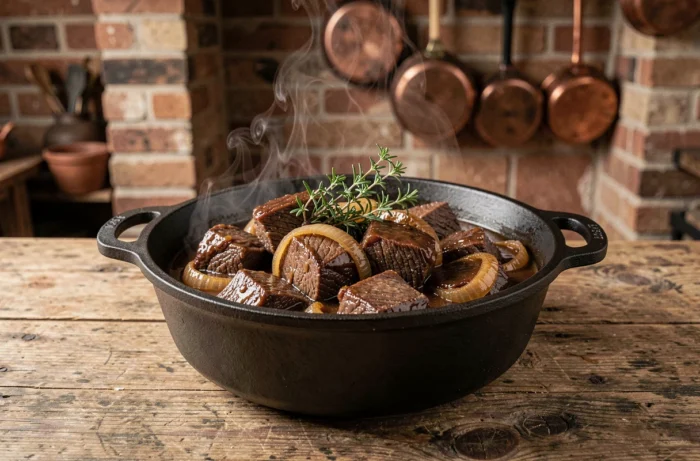
Flemish carbonade and beef bourguignon share the same principle: beef braised for a long time in an alcoholic liquid, with onions and spices. The comparison stops there. The cooking liquid, the preferred cuts of meat, the sweetening ingredients, and the time spent on the stove create two dishes with very different taste profiles. This article measures the concrete differences between these two traditional recipes.
Flemish carbonade and beef bourguignon: comparative table of fundamentals
| Criterion | Flemish carbonade | Beef bourguignon |
|---|---|---|
| Cooking liquid | Beer (dark, amber, or abbey) | Red wine (Burgundy) |
| Beef cuts | Chuck, beef cheek, flank | Brisket, flank, chuck, neck |
| Sweetening element | Brown sugar (vergeoise brune), gingerbread | None (natural sweetness of carrots) |
| Acidity / spiciness | Wine vinegar, strong mustard | Acidity of the wine, bouquet garni |
| Main vegetables | Onions | Onions, carrots, mushrooms, lardons |
| Slow cooking | Dutch oven on low heat or in the oven | Dutch oven on low heat or in the oven |
| Classic garnish | Fries or potatoes | Steamed potatoes, fresh pasta |
Beef bourguignon is a dish with a broader aromatic garnish, featuring several vegetables and lardons. Flemish carbonade focuses its palette on the beer-onion duo, enhanced by sugar and acidity.
To better understand the origin of Flemish carbonade and its regional variations, it should be noted that this recipe has never been uniquely codified. Practices vary regarding the use of gingerbread, vinegar, or the type of beer, depending on families and provinces.
Dark beer or red wine: the most structuring taste difference
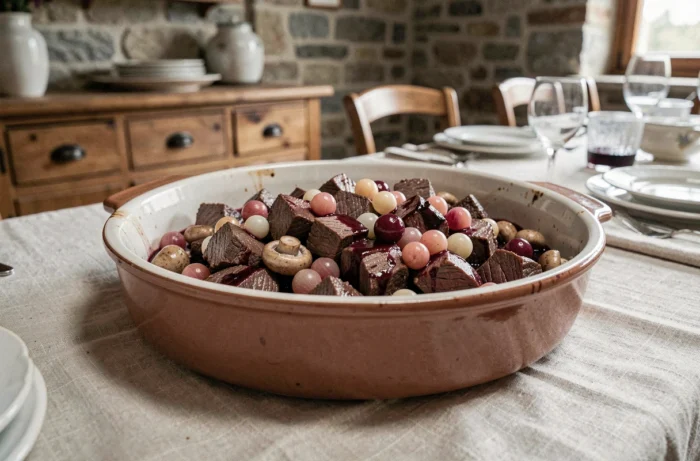
The choice of braising liquid is not merely a substitution of alcohol for alcohol. Beer alters the sweet-bitter balance much more than wine does with acidity. A dark or dubbel beer brings notes of roasting and caramel that amplify the sweetness of the brown sugar and gingerbread. A beer that is too bitter, on the other hand, can upset the balance and make the sauce harsh.
The red wine in bourguignon acts differently. Its tannins structure the sauce during the long cooking process, and its natural acidity eliminates the need to add vinegar. The reduction of the wine concentrates fruity aromas without ever tipping into bitterness.
Impact on the final sauce
The sauce of the carbonade is thicker, darker, with a pronounced sweet-sour base. The bourguignon sauce remains more fluid, tinted dark red, with a tannic roundness. These two sauces are not interchangeable on the plate: the former calls for fries to absorb its intensity, while the latter pairs better with steamed potatoes or tagliatelle that do not mask its finesse.
Choice of meat for Flemish carbonade and bourguignon: the gelatinous cuts in question
Both traditional recipes share a principle of slow cooking that requires cuts rich in collagen. Chuck works in both cases. The difference lies in one particular cut: beef cheek is particularly suited for carbonade. Its gelatin content gives a more cohesive sauce and a melting texture after several hours of cooking, as highlighted by the Brussels restaurant La Roue d’Or.
For bourguignon, brisket and neck are often preferred. These cuts withstand prolonged cooking while maintaining a fibrous structure that shreds into slices rather than falling apart. The result in the mouth differs: the carbonade leans towards a homogeneous tenderness, while the bourguignon retains more chewiness.
A often overlooked selection criterion: the cutting format
Carbonade is traditionally prepared with fairly large cubes of meat. Bourguignon accepts slightly smaller pieces, as the garnish (carrots, mushrooms, lardons) shares the plate. This detail alters the cooking time needed to achieve the same level of tenderness.
Traditional recipe: the ingredients that shift the taste
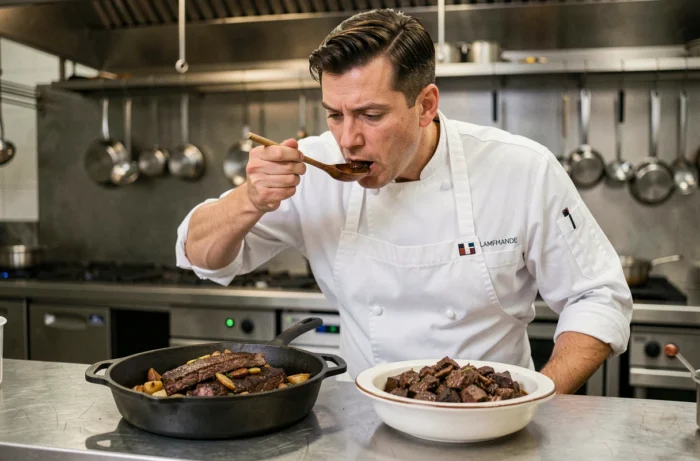
Beyond the liquid and the meat, three ingredients create the true dividing line between these two dishes:
- Gingerbread in the carbonade acts as a thickener and adds a spiced sweetness (cinnamon, anise). Spread with strong mustard, it melts into the sauce during cooking and gives it its characteristic consistency.
- Brown sugar (vergeoise brune) enhances the caramelized character. Combined with wine vinegar, it creates a sweet-sour balance that does not exist in bourguignon.
- The lardons and mushrooms in bourguignon provide an umami dimension and aromatic complexity that carbonade does not seek. Bourguignon plays on depth, while carbonade emphasizes contrast.
This difference in culinary philosophy explains why the two dishes, despite their common base of braised beef, do not substitute for one another on a menu.
Oven or Dutch oven cooking: time and method compared
Both recipes require slow cooking, but the cooking time is not comparable without considering the chosen cut and the cutting format. A whole beef cheek in carbonade requires a significantly longer duration than cubed chuck for bourguignon.
The cast iron Dutch oven remains the reference material for both preparations. Oven cooking, at moderate temperature, offers more even heat and reduces the risk of sticking to the bottom. For carbonade, the oven has an additional advantage: the gingerbread placed on the meat melts gradually without burning, which would be more difficult to control over direct heat.
Bourguignon, on the other hand, tolerates stovetop cooking better as its more liquid sauce (wine + stock) protects the meat from drying out. The oven is better suited for carbonade, while the Dutch oven on low heat is sufficient for bourguignon.
These two traditional recipes do not truly compete: they cater to distinct taste profiles. Flemish carbonade relies on the sweet-bitter-sour contrast brought by beer and gingerbread. Beef bourguignon builds its depth on the tannins of red wine and the diversity of its garnish. The choice between the two depends less on a ranking than on the flavor profile sought on a winter evening.