A sketchbook filled every evening does not make a profession. Between the pleasure of drawing and the reality of a position in an animation studio, there is a set of technical skills, a tailored portfolio, and market knowledge that a hobby alone does not provide. Transforming an artistic hobby into a career as an animated artist requires understanding what recruiters expect today, not what one imagines the profession to be.
Portfolio and production pipeline: what studios really evaluate
When a studio receives an application, it does not look at the quantity of drawings. It seeks the ability to fit into a specific production pipeline: storyboard, layout, animation, compositing. Each stage requires standardized deliverables, not free illustrations.
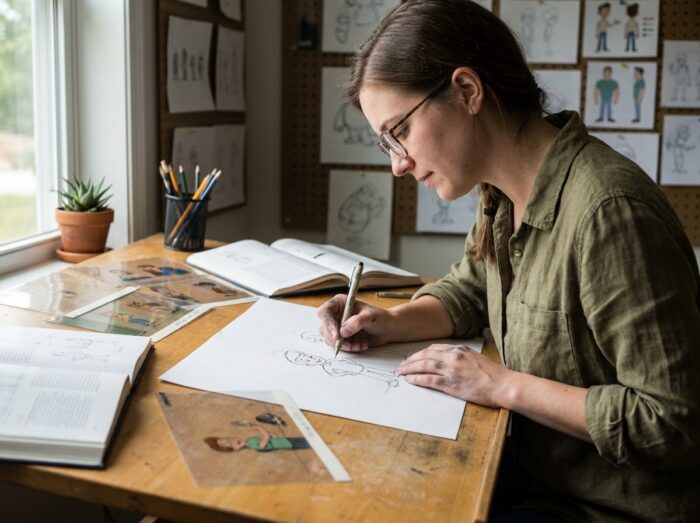
An effective portfolio demonstrates that one can work under constraints. Three or four short animated sequences, with characters consistent in their proportions and movements, are worth more than a gallery of polished portraits. Studios also check for proficiency in the 2D and 3D animation software used in production.
One can move from a passion for drawing to an animation school in Bordeaux or elsewhere, but training does not replace personal work on structured projects. Internships in studios remain the best way to understand real expectations and build a production-oriented portfolio.
- Include character design exercises with complete model sheets (front, profile, three-quarter, expressions)
- Produce at least one animated sequence of a few seconds showing a walk cycle and an action with timing
- Demonstrate the ability to adhere to an imposed artistic direction, not just personal style

Animation market in France: a context not to be ignored
French animation enjoys a strong international reputation. Several studios in France work on feature films and series exported worldwide. This image masks a more nuanced reality for beginners.
The number of applications far exceeds the available positions for recent graduates. Projects funded by major streaming platforms have experienced a slowdown after a phase of rapid expansion. According to Les Échos, citing the Datalab Audiens and the CNC, the sector is going through a contraction phase despite its notoriety.
For someone considering turning their drawing into a profession, this data changes the strategy. It is not enough to be a graduate: the portfolio, internships, and ability to work in a team become crucial as soon as one enters the market. Career change advice that presents animation as a naturally promising outlet does not reflect the current situation.
Expanded technical skills: animation, generative AI, and motion design
The profession of animation artist is no longer limited to pencil or even graphic tablet. Recent job offers show a clear expansion of the skills sought.
Studios now require proficiency in generative AI tools like Midjourney, Runway, or Kling, in addition to traditional animation software. The sought-after profile combines artistic sensitivity and technical control: knowing how to guide a generative tool to produce a result consistent with an artistic direction, then retouching and animating the result.
Motion design has also established itself as a cross-disciplinary skill. An artist who can animate a logo, edit a short sequence for social media, or produce graphic packaging significantly broadens their opportunities, including outside traditional animation studios.
What this means for a self-taught artist
A hobbyist who draws well but does not know video editing or the basics of motion design starts at a disadvantage compared to trained profiles. The good news is that these complementary skills can be acquired online with structured tutorials and regular practice. Feedback varies on the time needed, but a few months of targeted work is enough to produce presentable pieces.
Professional status and initial income for a freelance artist
Many artists start freelance before joining a studio. The choice of legal status has a direct impact on taxation and social protection.
- The artist-author regime is suitable for original creations (illustration, comic books, concept art sold with rights transfer). It grants access to a specific affiliation with social security
- The micro-enterprise is often chosen for service provision (motion design, commissioned animation) with a revenue ceiling and simplified accounting
- Combining both statuses is possible in some cases, but the line between original creation and service provision remains blurred and a source of adjustments
Before starting, checking with URSSAF which regime corresponds to the actual activity avoids administrative complications down the line. The first months rarely generate stable income: orders come through networking, recommendations, and the visibility of the online portfolio.
Training at an animation school: an accelerator, not a guarantee
An animation school structures learning, provides access to professional equipment, and connects students with industry professionals. It also allows for the creation of a final film in a team, an exercise that replicates the conditions of a real production project.
The diploma alone is not enough. What makes the difference upon graduation is the quality of the collective film, the contacts made during internships, and the ability to showcase regular personal work alongside the curriculum. A student who graduates without a solid personal portfolio starts almost from scratch in front of recruiters.
Transforming a drawing hobby into a career in animation requires more than graphic talent. The current market rewards versatile profiles capable of navigating between traditional animation, recent digital tools, and production constraints. Starting with a targeted portfolio, choosing the right legal status, and monitoring the evolution of required skills remains the most realistic path from the sketchbook to the end credits.