
Plaintel, a municipality in Côtes-d’Armor linked to the Saint-Brieuc urban area, has a modest real estate activity in size but dense in stakes. Between energy performance constraints, local urban planning, and the documentary validity of properties, a buying or selling project requires skills that go beyond simple matchmaking between seller and buyer.
Building permits and public data: what the activity in Plaintel reveals
Real estate agency pages rarely present local urban planning data. The public information Sit@del, which lists granted building permits, allows tracking the actual evolution of construction activity in the municipality.
This reading provides a concrete indication of the territory’s dynamics. A regular volume of granted permits signals a municipality where projects come to fruition, where land remains accessible, and where the instruction services operate within reasonable timeframes.
The DVF data (Demandes de Valeurs Foncières), from the General Directorate of Public Finances, complements this analysis by documenting the sales actually recorded and not the prices displayed in advertisements. The gap between the asking price and the signed price can vary significantly depending on the type of property and the neighborhood. Support that integrates this public data, beyond a simple catalog of listings, allows for calibrating an offer or a purchase proposal based on factual grounds.
For project holders looking to cross-reference this information with on-the-ground support, the services of Immobilier Plaintel cover both transaction and advice in the sector.
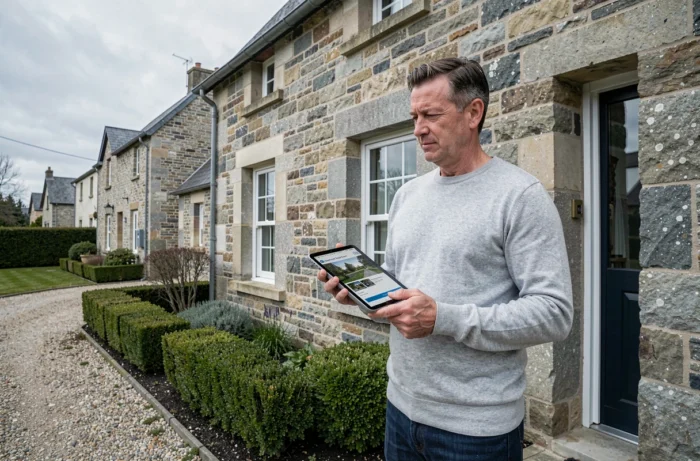
EPC and energy performance: a determining filter in Plaintel
The Climate and Resilience Law has transformed the energy performance diagnosis into an operational criterion, not just informative. For landlords, an EPC rated G now prohibits rental, and F classes will follow according to the regulatory schedule. This constraint directly affects the rental stock of small Breton municipalities, where part of the old buildings has not been renovated.
The specific case of small surfaces
Since July 1, 2024, a decree introduces a corrective coefficient for housing under 40 m². The calculation of the EPC penalized these surfaces disproportionately, and an earlier EPC can in some cases be recalculated using the ADEME simulator.
For an owner of a studio or small apartment in Plaintel, this verification can shift a property from class F to class E, altering its rental attractiveness and market value. Field feedback varies on this point: not all diagnosticians spontaneously offer this reevaluation, and some owners are unaware that it exists.
Documentary validity and seller obligations
A comprehensive real estate support does not limit itself to matchmaking. The validity of diagnostics (EPC, asbestos, lead, sanitation) conditions the signing of the authentic deed. An incomplete or expired file delays the sale or even jeopardizes it.
- The EPC is valid for ten years, but EPCs carried out before July 1, 2021, follow specific expiration rules that must be checked on a case-by-case basis
- The asbestos diagnosis remains valid indefinitely if no trace has been detected; however, a positive result requires periodic monitoring
- The state of the non-collective sanitation installation, common in rural municipalities like Plaintel, must be less than three years old at the time of sale
An agent who monitors these deadlines prevents the seller from discovering a blockage the day before the signing at the notary.
House with garden or buildable land: two distinct purchasing logics
The market in Plaintel is divided between existing houses, often with a garden and garage, and buildable land on which a new construction project can be considered. These two segments do not respond to the same evaluation criteria.

For an existing house, the condition of the kitchen, bathroom, and heating system directly impacts the overall budget. The displayed purchase price does not reflect the actual installation cost if energy renovation work is required to achieve an acceptable EPC class.
For land, local urban planning constraints determine what can be built: footprint, height, connection to networks, obligations related to the Local Urban Planning Plan. These elements can be consulted at the town hall, but their interpretation requires a technical reading that not all buyers master.
Agency fees in the transaction
The question of fees consistently arises in real estate projects. In Plaintel, as elsewhere, agency fees are borne by the buyer or the seller depending on the signed mandate. The mention must clearly appear on each advertisement, along with the agent’s RSAC number and the details of the scale.
A often overlooked point: fees generally cover the entire service, from the initial estimate to the signing of the deed. Comparing rates between agencies without comparing the associated service scope amounts to comparing different services.
Real estate visit in Plaintel: beyond the living area
A visit to a house or apartment in Plaintel benefits from going beyond mere visual impression. Several technical elements deserve particular attention:
- The orientation of the land and the exposure of the main rooms influence thermal comfort and, by extension, the energy consumption of the housing
- The presence of a garage or outbuilding can modify the declared usable area and the associated local taxation
- The state of the networks (water, electricity, sanitation) in the older neighborhoods of the municipality sometimes requires a complementary diagnosis that is not mandatory but recommended
The technical visit complements the aesthetic visit and allows for formulating an offer that incorporates the real cost of the property, including work.
In a local market where transactions remain limited in volume, each project deserves an analysis that goes beyond consulting listings. Public data, regulatory constraints, and the specificities of Breton buildings constitute a foundation of information that only structured support can fully exploit.